

What Happens During On-Course Golf Instruction?

Practicing your golf swing on the driving range is one thing. Making that same swing when you’re standing over a ball on the fairway, facing a narrow landing area, or trying to save par from a difficult lie is another. The golf course introduces challenges that simply can’t be recreated during a typical practice session.
That’s where on-course golf instruction makes a difference. Instead of focusing exclusively on swing mechanics, your instructor helps you understand how to play the game in real situations. From club selection and course management to shot preparation and decision-making, these lessons connect the skills you’ve practiced with the situations you’ll encounter during an actual round.
At Bird Golf Academy, on-course instruction is an important part of our personalized golf learning experience. Our private golf instruction combines focused practice with guided play, giving students the opportunity to develop their skills and learn how to apply them where they matter most.
What Is On-Course Golf Instruction?
On-course golf instruction is a lesson that takes place on an actual golf course rather than exclusively on a driving range or practice green. You play real holes alongside a professional instructor who observes your decisions, evaluates your technique, and provides feedback throughout the round.
Unlike a traditional lesson that might focus on one particular movement, on-course instruction considers the many factors that influence your performance.
Your instructor can help you understand why certain shots work, what causes others to go wrong, and how to approach similar situations in the future.
The goal isn’t simply to hit better shots. It’s to become a more capable golfer who understands how to manage different situations, make informed decisions, and play with greater confidence.
1. Your Instructor Observes How You Actually Play
One of the first things that happens during on-course golf instruction is observation.
Your instructor watches how you approach each hole, prepare for shots, select clubs, and respond to different playing conditions. This provides valuable insight into habits that may not be noticeable during a driving range session.
For example, you might consistently strike the ball well during practice but struggle with accuracy once you’re on the course. Your instructor may discover that your alignment changes when you’re aiming toward a specific target or that you rush your setup when other golfers are watching.
They may also notice that your swing becomes less consistent when you encounter an uneven lie or feel pressure to hit a particular shot.
By seeing your game in its natural environment, your instructor can identify the areas that deserve the most attention.
2. You Learn How to Make Better Course Management Decisions
Golf isn’t just about how well you swing the club. It’s also about knowing which shot to attempt and when.
During on-course instruction, your instructor helps you evaluate each hole and develop a practical strategy based on your abilities.
This may involve deciding where to aim your tee shot, choosing a safer approach to the green, or determining when it’s better to lay up rather than attempt a difficult carry.
For instance, imagine you’re facing a long par 4 with a water hazard protecting the front of the green. You might instinctively reach for a fairway wood and attempt to cover the entire distance.
Your instructor may explain why playing a shorter shot to a comfortable wedge distance could give you a better opportunity to finish the hole without taking unnecessary risks.
These discussions help you recognize that smart decisions can be just as important as solid ball striking.
As part of the golf lessons, Bird Golf instructors help students develop a better understanding of course strategy while working on the technical skills needed to execute their shots.
3. You Practice Different Shots From Real Playing Conditions
The driving range usually provides a relatively flat hitting surface and predictable conditions. A golf course rarely offers that same consistency.
Throughout an on-course lesson, you may encounter uphill lies, downhill lies, uneven fairways, thick rough, fairway bunkers, and greenside hazards.
Each situation requires adjustments to your setup, club selection, and expectations.
Your instructor can demonstrate how to approach these shots and explain why certain adjustments are necessary.
For example, when playing from an uphill lie, you may need to account for changes in ball flight and distance. When hitting from thick rough, you’ll learn how the grass can influence clubhead speed and contact.
Instead of trying to remember general advice, you get to practice these adjustments in the exact situations where they’re needed.
Over time, this experience helps you become more comfortable with shots that once seemed unfamiliar or intimidating.

4. You Work on Your Pre-Shot Routine
A consistent pre-shot routine helps golfers prepare for each shot with a clear plan.
However, many players abandon their routines when they feel rushed, frustrated, or uncertain about what to do next.
During on-course instruction, your instructor can help you establish a repeatable process that fits your natural playing style.
That process might include evaluating the lie, selecting a target, choosing the appropriate club, taking a practice swing, and committing to the shot.
The objective is to create a routine that supports concentration without introducing unnecessary swing thoughts.
Your instructor may also help you recognize when you’re spending too much time analyzing a shot or allowing a previous mistake to influence your next decision.
With practice, a reliable routine can make your preparation feel more natural and help you approach each shot with a clearer mindset.
5. You Receive Guidance on Your Short Game
A significant portion of golf takes place around the greens, making short-game instruction an essential part of improving your overall performance.
During an on-course lesson, your instructor can observe how you approach chips, pitches, bunker shots, and putts in real playing conditions.
You might learn how to choose between a bump-and-run and a higher-lofted shot, how to evaluate the amount of green available, or how to select a landing spot that gives you a better chance of controlling the ball.
Putting instruction may involve reading slopes, evaluating green speed, and developing a consistent approach to distance control.
These lessons are especially valuable because they show you how to select the appropriate shot rather than relying on the same technique in every situation.
For golfers who regularly lose strokes around the greens, improving these decisions can make a noticeable difference in their scores.
6. You Learn to Handle Pressure and Recover From Mistakes
Almost every golfer has experienced a round where one poor shot seems to affect everything that follows.
A missed fairway leads to frustration. The next shot becomes rushed. Suddenly, a manageable hole turns into a difficult one.
On-course instruction gives your instructor the opportunity to observe how you respond to these moments and help you develop a more productive approach.
Instead of dwelling on the previous shot, you can learn to assess your current situation and make the best decision available.
Your instructor may also help you recognize when frustration is influencing your club selection, tempo, or shot preparation.
This kind of guidance is difficult to replicate on a driving range because the emotional challenges of golf often become more apparent during actual play.
Learning to recover mentally from mistakes is an important part of becoming a more consistent golfer.
7. You Learn How to Take Your Range Swing to the Golf Course
One of the biggest challenges golfers face is transferring improvements from practice sessions into competitive or recreational rounds.
You might make excellent contact during a lesson, only to struggle with the same movement once you’re playing.
Several factors can contribute to this difference, including changing targets, unfamiliar lies, pressure, and the temptation to think about too many technical details.
During on-course instruction, your instructor helps you simplify the transition.
Rather than concentrating on every mechanical adjustment, you may focus on one specific swing thought, a target, or a consistent rhythm.
Your instructor can also explain when it’s appropriate to make a technical adjustment and when it’s better to trust the swing you’ve been practicing.
This connection between practice and actual play is one of the reasons golfers choose golf schools with PGA instructors that combine technical lessons with guided on-course experience.
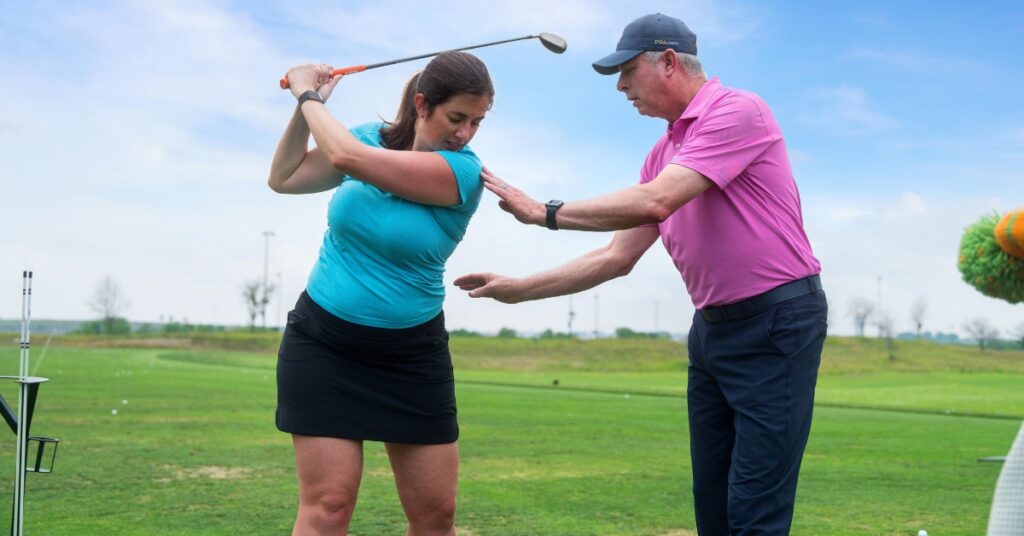
8. You Receive Immediate Feedback After Each Shot
During a typical round, you might hit a poor shot and spend the next several holes wondering what went wrong.
Was your alignment incorrect? Did you choose the wrong club? Was the problem your swing, or did you simply misjudge the conditions?
With an instructor beside you, those questions can be addressed while the situation is still fresh.
Your instructor can explain what happened, identify the most important adjustment, and help you prepare for the next opportunity.
Just as importantly, they can reinforce good decisions and successful techniques.
For example, a shot might miss the green even though you made the correct club selection and executed a reasonable swing. Your instructor can help you recognize that the result doesn’t always mean the decision was wrong.
This immediate feedback encourages a better understanding of your game and reduces the temptation to make unnecessary changes after every imperfect shot.
How Does On-Course Instruction Work at Bird Golf Academy?
At Bird Golf Academy, on-course instruction is integrated into a comprehensive golf learning experience rather than treated as a separate activity.
Our golf schools combine personalized instruction, focused practice, and daily on-course learning to help students build skills they can use beyond their time at the academy.
Personalized instruction
Students receive individualized guidance based on their experience, goals, strengths, and areas for improvement. Our Eagle program offers one-on-one instruction, while the Buddy program provides a two-student-to-one-instructor experience.
Daily on-course learning
Each school day includes time on the course, where students apply what they’ve practiced and receive guidance on strategy, shot selection, and performance in real playing situations.
A complete learning experience
Our schools include six hours of daily instruction, video analysis, mental game guidance, and lifetime follow-up instruction. Resort lodging is also included, with commuter rates potentially available.
By combining range instruction with time on the course, students have the opportunity to understand not only what needs to improve but also how those improvements translate into their everyday game.
Who Can Benefit From On-Course Golf Lessons?
On-course golf instruction can benefit golfers at nearly every experience level.
Beginners can learn how to navigate a golf course, understand basic etiquette, select appropriate clubs, and approach different shots without feeling overwhelmed.
Intermediate players can work on improving consistency, reducing avoidable mistakes, and developing better strategies for challenging holes.
Experienced golfers may benefit from refining their course management, improving decision-making under pressure, and identifying small habits that affect their scoring.
On-course instruction can also be particularly helpful for golfers who feel their performance during practice doesn’t reflect what happens during an actual round.
For those interested in dedicated instruction over several days, a three-day golf school can provide the time needed to work on technical skills, apply them during guided play, and reinforce what they’ve learned.

Is On-Course Instruction Better Than Driving Range Lessons?
Both types of instruction serve important purposes, and the most effective learning experience often combines them.
Driving range lessons allow golfers to focus on specific movements, repeat drills, and make technical adjustments in a controlled environment.
On-course instruction helps golfers apply those skills while managing changing conditions, making strategic decisions, and responding to the challenges of actual play.
For example, a golfer struggling with a slice may initially need range instruction to improve their grip, alignment, or swing path.
Once those adjustments become more comfortable, on-course instruction can help the golfer understand how to use the improved swing when facing a narrow fairway or a difficult tee shot.
Rather than choosing one type of instruction over the other, golfers can benefit from understanding how each contributes to long-term improvement.
Frequently Asked Questions About On-Course Golf Instruction
Do you play actual holes during on-course golf lessons?
Yes. On-course instruction takes place during real golf play, allowing your instructor to observe how you approach different holes and provide feedback on technique, strategy, and decision-making. The number of holes played depends on the lesson or golf school program.
Do I need to be an experienced golfer to take on-course lessons?
No. On-course instruction can be adapted for beginners, intermediate players, and experienced golfers. Beginners may focus on fundamentals and learning how to navigate the course, while more experienced players may concentrate on strategy, consistency, and scoring.
What should I expect my golf instructor to teach on the course?
Your instructor may cover club selection, course management, shot preparation, alignment, uneven lies, short-game techniques, putting, and mental strategies. The lesson is typically tailored to the areas of your game that need the most attention.
Can on-course golf instruction help lower my scores?
It can help you identify opportunities to save strokes through better decisions, improved shot execution, and more effective course management. While results vary, learning to avoid unnecessary risks and recover from difficult situations can contribute to more consistent scoring.
Should I take on-course lessons or regular golf lessons first?
That depends on your current skill level and goals. Golfers who need to develop basic swing fundamentals may benefit from range instruction, while those who struggle to apply their skills during a round may find on-course lessons particularly valuable. A program that combines both approaches can address these needs together.
Learn to Play Better Golf Where It Matters Most
Golf improvement isn’t measured only by how well you hit the ball during practice. It’s also reflected in the decisions you make, the challenges you overcome, and the confidence you develop while playing.
On-course golf instruction gives you the opportunity to work through those situations with professional guidance, helping you better understand your game and develop skills that carry over into future rounds.
At Bird Golf Academy, we believe meaningful improvement comes from combining personalized instruction with practical experience. Our golf schools are designed to help you build a more complete game through focused practice, individual attention, and daily on-course learning.
Ready to make your practice count on the course? Explore our golf school programs and discover how the Ultimate Golf Learning Experience® can help you become a more confident, consistent player.
