

Golf in Colorado Springs with Bird Golf Academy: Why Altitude Makes You a Better Player
Your first swing at altitude is a strange experience.
You take your normal 7-iron, make what feels like your normal swing, and the ball just keeps going. Not in a wind-aided, lucky bounce kind of way. It genuinely flies farther and stays in the air longer than physics should allow at sea level.
If you’re not prepared for it, you’ll fly the green. If you are prepared for it, you’ll still probably fly the green the first few times because knowing something intellectually and trusting it in the moment are two different things.
That’s Colorado golf. And that’s exactly why it works so well as a place to learn.
Why Altitude Changes Everything
At Cheyenne Mountain Resort in Colorado Springs, you’re playing at roughly 6,000 feet above sea level. The air is thinner, which means less resistance, which means the ball travels about 10% farther than it would at sea level.
A 150-yard shot becomes 165 yards. Your pitching wedge now goes the distance your 9-iron used to cover. Every club in your bag plays differently, and you have to recalibrate everything you thought you knew about distance.
For a lot of golfers, this sounds frustrating. And for the first few holes, it is. But then something interesting happens.
You stop relying on your assumptions and start paying attention to what’s actually happening. You watch the ball flight more carefully. You notice how the thinner air affects trajectory. You become more deliberate about club selection instead of just grabbing whatever feels right.
In other words, you start thinking like a better golfer.
That recalibration doesn’t go away when you get back to sea level. The awareness sticks. You’ve spent three or four days truly paying attention to distance, trajectory, and conditions in a way you probably haven’t since you first started playing. That discipline transfers.
The Course That Won’t Let You Get Lazy
The Country Club of Colorado was designed by Pete Dye, which tells you most of what you need to know. Dye didn’t build courses that flatter your game. He built courses that expose weaknesses you didn’t know you had.
This one stretches to just under 7,000 yards from the back tees, par 71, with a slope rating that varies depending on which tees you play. But the real challenge isn’t length. It’s that every hole asks you to make a decision.
Doglegs where the aggressive line requires a precise carry over trouble. Approach shots to greens guarded by water on one side and bunkers on the other. Par 5s where going for it in two is possible but only if you’ve positioned your drive correctly.
There’s no autopilot here. You can’t just grip it and rip it and hope things work out. You have to think your way through the round.
For a golf school, that’s perfect. Your instructor isn’t just watching your swing. They’re watching how you think, how you assess risk, how you react when a shot doesn’t go as planned. Those insights are often more valuable than any mechanical adjustment.
The Pace You Didn’t Know You Needed
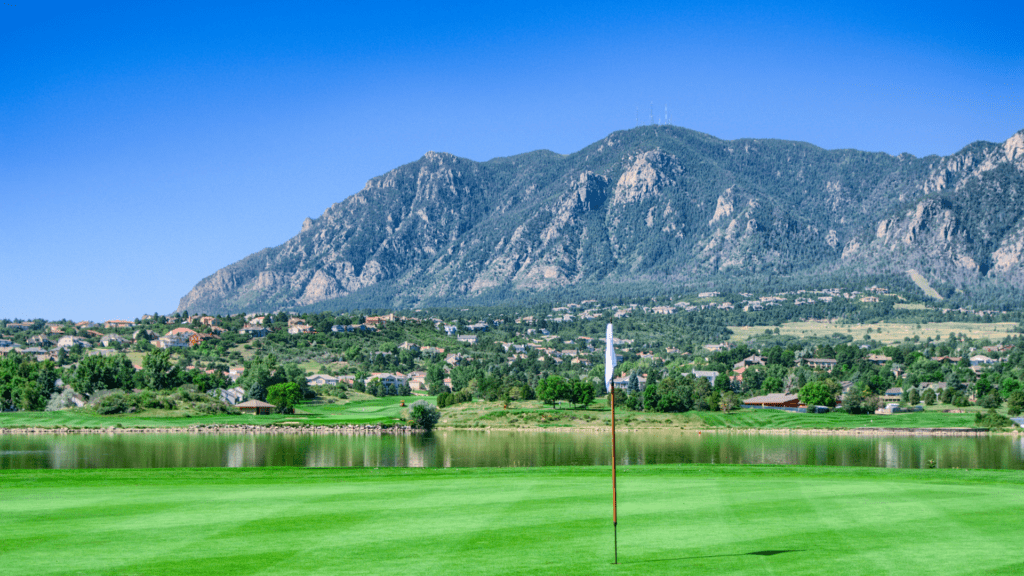
Colorado Springs sits at the base of the Rockies, and Cheyenne Mountain Resort takes full advantage of that setting. The views are immediate and constant. Pikes Peak dominates the skyline. The air is crisp in a way that makes you want to take deeper breaths.
It’s hard to stay wound up in a place like this.
Between sessions, you have time to step away. Maybe you grab a coffee and sit outside. Maybe you explore the resort. Maybe you just stare at the mountains for a while and let your mind wander.
That downtime matters more than you’d think. Improvement doesn’t come from constant grinding. It comes from cycles of effort and rest, focus and release. The Colorado setting naturally supports that rhythm in a way that’s hard to manufacture.
The resort itself is what you’d expect from a full-service destination. Comfortable rooms, solid dining, a spa if you want it. Nothing flashy, but everything you need. You’re not there to be entertained. You’re there to get better at golf. The resort understands that and stays out of your way.

The Instructors Who Actually Get It
One of the biggest differences between a Bird Golf school and a weekend clinic is the quality of instruction. These aren’t club pros who teach a few lessons on the side. These are PGA and LPGA professionals with decades of experience, many of whom have competed at high levels themselves.
At the Colorado location, you’re working with instructors who understand that every golfer is different. They don’t try to force you into a textbook swing. They work with your body, your tendencies, and your goals.
Some students are near-beginners who need foundational work. Others are single-digit handicaps trying to break through a specific barrier. The instruction adapts to meet you wherever you are.
What stands out is how good these instructors are at simplifying complex ideas. They don’t overwhelm you with technical jargon. They give you one or two clear things to focus on, and they give you drills that actually work.
What You Actually Take Home
The real test of any golf school is what happens after you leave.
Do the changes hold up? Do you remember what you worked on? Can you apply it on your own without an instructor standing next to you?
With Colorado, the answer tends to be yes, for a few reasons.
First, the altitude forces you to develop better awareness. You can’t just mindlessly hit balls. You have to pay attention to what’s happening, and that habit carries over.
Second, the on-course instruction gives you real reference points. When you face a similar situation later, you remember not just what to do but how it felt when you did it correctly.
Third, the drills you learn are simple enough to practice on your own. You’re not dependent on an instructor being there. You have the tools to self-correct.
And finally, the ongoing support means you’re not alone. If you get stuck, you can reach out. That safety net makes a huge difference in maintaining progress.
Who This Works For
Bird Golf schools attract a wide range of golfers. Some are just getting started. Others have been playing for 40 years and are trying to fix bad habits that have calcified over time.
What they tend to have in common is frustration. They’ve hit a wall. They’ve tried YouTube videos, magazine tips, and occasional lessons, but nothing has moved the needle in a meaningful way.
Colorado works particularly well for golfers who are serious about improvement but don’t have unlimited time. The condensed, immersive format lets you make more progress in three or four days than you’d make in six months of sporadic practice.
It also works well for anyone who benefits from a change of environment. Sometimes you need to get away from your normal routine to see things differently. Colorado provides that reset.
The Turning Point
Most golfers who attend a Bird Golf school in Colorado talk about a specific moment when something clicked.
Maybe it was a drive on the 8th hole where everything felt effortless and the ball flew 30 yards past their normal distance. Maybe it was a bunker shot that came out soft and stopped next to the pin. Maybe it was just a sudden understanding of why their misses were happening and how to prevent them.
Those moments matter. They’re proof that improvement is possible. And once you’ve felt it, you can work toward recreating it.
That’s ultimately what separates a good golf school from a great one. It’s not just about learning new information. It’s about experiencing what better golf actually feels like so you have something concrete to work toward.
Is Colorado Right for You?
If you’re looking for a resort vacation with a little golf on the side, this probably isn’t it. Cheyenne Mountain is beautiful and comfortable, but the focus is squarely on improvement.
If you’re serious about getting better, if you’re willing to put in real effort over multiple days, and if you want expert instruction in a setting that naturally supports focus, then Colorado makes a lot of sense.
The altitude will challenge you. The course will expose your weaknesses. The instruction will give you the tools to address them. And the environment will give you the space to actually absorb what you’re learning.
You’ll leave tired, probably a little sunburned, and with a much clearer understanding of your game than you had when you arrived.
More importantly, you’ll leave with a plan. Not vague goals, but specific things to work on and a path forward.
That clarity is what makes the trip worth it.
