

Why Do I Hit the Ball Well on the Driving Range but Not on the Golf Course?

You are hitting one solid shot after another on the driving range. Your irons feel crisp, the driver is finding its target, and your swing finally feels repeatable.
Then you step onto the first tee, and suddenly it feels like you brought a completely different golf swing with you.
If this sounds familiar, you are far from alone. The difference between hitting the ball well on the driving range and performing consistently on the golf course is one of the most common frustrations golfers experience.
The good news is that your swing may not be the entire problem.
Playing golf requires much more than reproducing a technically sound swing. Every shot on the course presents a different target, lie, club, consequence, and decision. Learning to manage those variables is one reason personalized golf instruction can be so valuable. Instead of focusing only on what happens on the practice tee, effective instruction should help you understand how to use your swing where your score is actually determined: on the golf course.
Why Is Golf Easier on the Driving Range?
The driving range gives golfers something the course rarely provides: repetition under controlled conditions.
You can hit several 7-irons in a row from a flat lie. If the first shot is poor, you immediately pull another ball over and try again. There is little consequence for a mistake, and you already know which club you are going to hit next.
On the golf course, you usually get one opportunity.
You may hit a driver from the tee, wait several minutes, hit a 6-iron from an uneven lie, then play a 30-yard pitch before attempting a six-foot putt. Every shot asks a different question.
That difference changes the way you swing, think, and react.
Repetition Can Hide Problems
Hitting the same club repeatedly can make it easier to find a rhythm.
Imagine hitting 20 balls with a 7-iron. After several swings, your body begins adjusting. You become familiar with the movement, timing, and feel required for that particular shot.
That can be productive when you are working on a specific swing change, but it does not completely reproduce the demands of playing golf.
On the course, you rarely hit the same shot twice in a row.
One simple way to make range practice more realistic is to change clubs and targets frequently. Hit a driver, then an iron, followed by a wedge. Imagine that each ball represents a different shot on a hole.
Instead of simply practicing your swing, start practicing the decisions and routines you will need on the course.
Your Lie Is Almost Never Perfect on the Golf Course
Most driving ranges give you relatively level hitting areas and predictable lies.
The golf course does not.
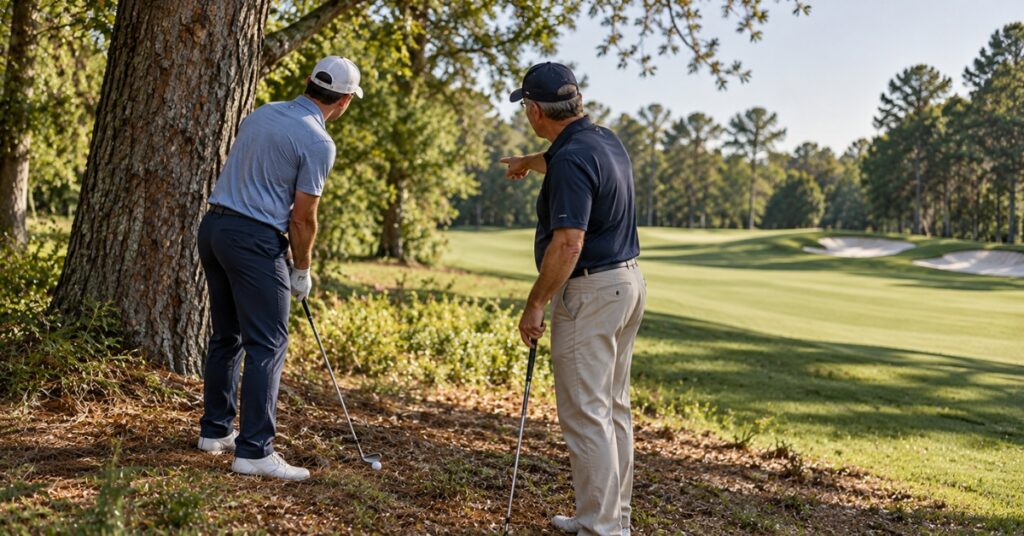
Your ball may be above your feet, below your feet, sitting in thick rough, resting on firm turf, or positioned on an uphill or downhill slope. Wind, temperature, elevation, hazards, and course conditions can also affect the shot.
A swing that produces an excellent result from a flat range lie may require adjustments when the conditions change.
This is one reason on-course golf instruction can reveal things that are difficult to identify on a practice tee. An instructor can observe not only how you swing but how you adjust to the situations you actually encounter during a round.
The goal is not simply to build a swing that works under perfect conditions. It is to develop a game that can adapt.
Pressure Changes the Way You Swing
There is usually very little pressure attached to a range ball.
Hit one poorly and another ball is waiting.
That changes dramatically when you stand over a tee shot with out-of-bounds down the right side or face an approach over water.
Golfers often respond to that pressure physically. Grip pressure can increase. Tempo may become quicker. The backswing can shorten or become rushed. Some golfers become tentative, while others try to guide the ball toward the target.
Even subtle changes can alter contact and ball flight.
This does not necessarily mean your swing disappeared between the range and the first tee. It may mean your normal motion changed because the situation changed.
You May Be Thinking Too Much About Your Swing
The range is an appropriate place to work on mechanics.
The golf course is where you need to play.
Problems can arise when golfers take several technical swing thoughts onto the course with them.
Keep your head here. Turn your shoulders. Shift your weight. Don’t come over the top. Keep your arm in position.
By the time you are ready to hit the ball, you may be thinking about five different movements instead of the shot in front of you.
Technical work has a purpose, but eventually the movement needs to become something you can trust.
Bird Golf’s golf teaching philosophy is built around the fact that golfers are individuals rather than products of a single swing method. Effective instruction identifies the golfer’s strengths and weaknesses and creates a path toward improvement that can ultimately be taken onto the course.
That last part matters.
A better golf swing is useful only when you can play golf with it.
Your Practice Routine May Not Look Enough Like Golf
Many golfers practice in blocks.
They hit 20 wedges, 20 mid-irons, and 20 drivers.
That can be useful when learning or reinforcing a movement, but your practice should eventually become more representative of an actual round.
Try Playing a Course on the Range
Visualize a familiar golf course while practicing.
Imagine the first hole requires a driver. Pick a specific target and hit one drive.
Based on the result, choose the club you would likely need for the approach. Hit one ball with that club.
Then move to the next imaginary hole.
The exercise forces you to change clubs, targets, and intentions after almost every shot. More importantly, you only get one attempt at each shot.
That begins to introduce some of the variability you encounter on the course.
Use Your Full Pre-Shot Routine
Do not reserve your pre-shot routine for competitive rounds.
Practice it.
Pick a target. Determine the shot you want to hit. Take your normal practice swing if you use one. Set up to the ball and commit.
Creating a consistent process can give you something familiar to rely on when the environment around you changes.
Course Management Could Be Costing You More Than Your Swing
Sometimes a golfer believes the swing is failing when the bigger problem is decision-making.
Suppose you hit a poor drive and find yourself behind a tree. You attempt a low-percentage recovery shot, clip a branch, and make double bogey.
Was the swing really responsible for the score?
Golf requires knowing when to attack and when to accept the situation in front of you.
Club selection, target selection, typical shot shape, hazards, wind, pin position, and your own tendencies should all influence the decision.
This is another important difference between practicing and playing. A driving range can help develop technique, but it cannot fully reproduce the decisions required over 18 holes.
Bird Golf incorporates daily playing lessons into its private golf school programs, allowing students to work with their instructor in actual playing situations. Rather than separating swing instruction from playing golf, students have opportunities to apply what they are learning to real lies, targets, conditions, and decisions.

Stop Expecting Perfect Shots
Another reason range performance does not always transfer is expectation.
After hitting dozens of balls during a productive practice session, you may begin expecting that same quality of contact on every shot during your next round.
Golf does not work that way.
Even very good players hit imperfect shots. The difference is often how well they manage those misses.
Instead of asking, “How do I hit every shot perfectly?” consider asking:
- Where is the safest place to miss?
- What is my most reliable shot in this situation?
- Which target gives me the largest margin for error?
- What club can I swing confidently?
- What is the smartest way to get the ball into the hole from here?
Scoring is not a test of how many perfect swings you can make. It is a test of how effectively you can manage your entire game.
Learn to Trust Your Swing on the Course
Taking your range game to the golf course requires trust.
When golfers are making a swing change, the new movement may initially feel unfamiliar. Under pressure, there is a natural temptation to return to the old motion because it feels comfortable.
That is exactly where guided on-course practice becomes valuable.
Bird Golf students work privately with their instructor, with 1:1 and 2:1 instruction options available. The school’s format combines practice sessions with daily on-course coaching, giving golfers the opportunity to reinforce changes while actually playing.
Working with experienced PGA and LPGA golf instructors also gives golfers immediate feedback when the result on the course differs from what they were seeing on the range.
An instructor can determine whether the issue is technical, mental, strategic, or simply the result of adapting to a different lie or situation.
How to Take Your Range Game to the Golf Course
If your range swing regularly disappears during a round, start by changing the way you practice.
Give every ball a purpose. Pick specific targets instead of simply hitting toward an open field. Change clubs regularly. Practice your pre-shot routine. Introduce imaginary hazards and consequences. Spend time practicing from different lies whenever possible.
Most importantly, learn to separate practice from performance.
When you are working on technique, focus on the movement you are trying to develop. When you are playing, shift your attention toward the target, the shot, and the decisions required to play the hole.
You do not need to create a perfect golf swing before you can play better golf.
You need a swing you understand and trust, along with the ability to manage it under real conditions.
The Range Is Where You Build It. The Course Is Where You Learn to Use It.
Improvement should not stop when you leave the practice tee.
The golf course introduces variables that cannot be completely recreated by hitting ball after ball from the same position. Different lies, changing targets, hazards, wind, club selection, pressure, and course strategy are all part of playing the game.
That is why Bird Golf combines personalized instruction with daily playing lessons. Students can work on their games in a controlled practice environment and then take those changes directly onto the course with their instructor.
With golf school locations throughout the United States and internationally, golfers can choose a destination and receive a program customized around their individual games and goals.
The objective is not simply to help you hit better shots on the range. It is to help you understand your game well enough to take those shots to the golf course, where they matter most.
Frequently Asked Questions
Why do I hit golf balls better at the range?
The driving range provides a more controlled environment. You often hit several shots with the same club from a relatively flat lie, which makes it easier to develop rhythm and correct mistakes immediately. On the golf course, clubs, targets, lies, and situations continually change.
Why does my golf swing feel different on the course?
Pressure, target awareness, uneven lies, hazards, waiting between shots, and changing clubs can all affect how you move. Some golfers also become more conscious of their mechanics on the course, which can interfere with their normal tempo and routine.
How can I make driving range practice transfer to the golf course?
Make practice more variable. Change clubs and targets frequently, use your complete pre-shot routine, imagine specific holes or hazards, and give yourself only one opportunity to execute certain shots.
Should I think about swing mechanics while playing?
A simple swing cue can sometimes be useful, but carrying several technical thoughts onto the course can make it difficult to focus on the shot itself. Technical changes are generally developed during practice and then gradually incorporated into a more target-focused playing routine.
Can on-course golf lessons help?
On-course instruction allows a coach to observe factors that may not appear on the driving range, including club selection, course management, uneven lies, pre-shot routines, reactions to poor shots, and changes in technique under pressure. That information can help identify why good range performance is not translating into lower scores.
What makes Bird Golf’s approach different?
Bird Golf combines private, individualized instruction with practice and daily on-course playing lessons. Students work with their own instructor rather than being placed into a large group with unfamiliar golfers. This allows instruction to address both swing mechanics and how the golfer actually plays the game.
