

How to Practice Smarter Between Golf Lessons
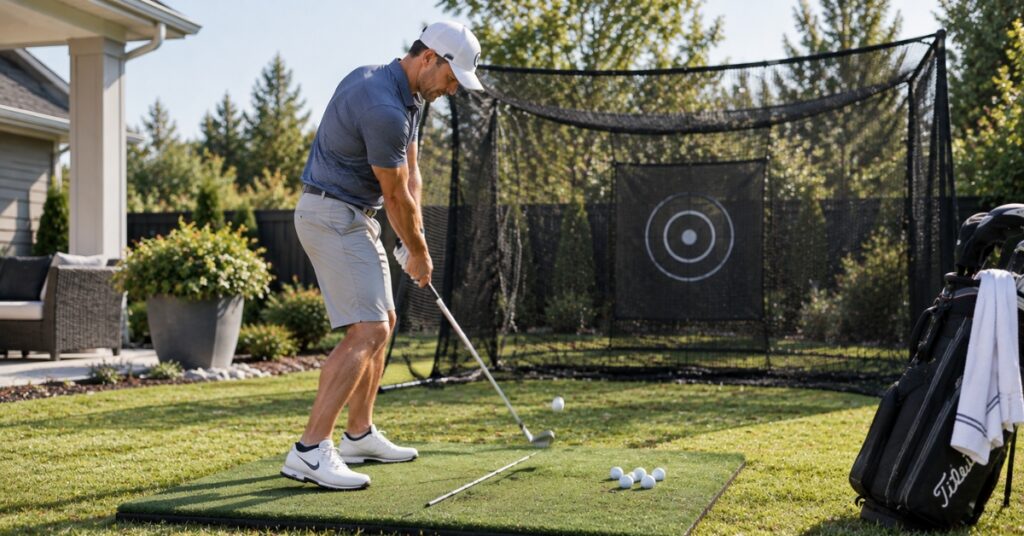
‘You leave your golf lesson feeling great. Your instructor identified the issue, gave you a clear adjustment, and you hit some of the best shots of your life on the lesson tee. You drive home replaying those crisp contact sounds in your head, already planning your next range session.
Then you show up to practice.
You grab a bucket, pull out your 7-iron, and start hitting balls. Things feel good for the first few shots. Then something drifts. You try to recreate what your instructor showed you, but it doesn’t quite feel the same. You hit a few more. Some are okay. Some aren’t. You’re not sure if you’re doing it right anymore, so you try something else. Then something else. By the end of the bucket, you’re not entirely sure what you worked on or whether it helped.
Sound familiar?
Most golfers don’t fail because they lack motivation after a lesson. They fail because they don’t know how to practice effectively on their own. They show up, hit balls, and hope repetition alone will lock in the changes. But without structure, practice doesn’t build improvement. It just burns time and grooves uncertainty.
This is one of the biggest gaps golfers face between lessons, and later in this article, we will talk about how Bird Golf Digital can help solve that problem.
Now, the good news is that smarter practice does not require more time or more effort. It requires more intention. Here is how to make the hours you spend between lessons actually count.
Start With a Focused Practice Plan
The biggest mistake golfers make after a lesson is showing up at the range without a plan.
They grab a bucket and start hitting. Driver first, maybe, because it’s fun. Then some irons. Maybe a few wedges at the end. The session has no structure, no specific goal, and no clear way to measure whether it helped.
Compare that to a focused practice plan. Before you hit a single ball, you know exactly what you’re working on. Maybe it’s the grip change your instructor showed you. Maybe it’s feeling the proper weight shift in your backswing. Maybe it’s hitting controlled 7-irons with a specific feel or thought.
A focused practice plan answers three questions before you start:
What am I working on today? One thing. Not three things. One specific adjustment or feel from your last lesson.
How will I practice it? What drill did your instructor give you? What progression should you follow? What’s the structure of this session?
How will I know if it’s working? What does success look like? Better contact? More consistent ball flight? A specific feel you’re trying to create?
When you can answer those three questions, you’re not just hitting balls. You’re practicing with purpose.
Most golfers try to work on everything at once. Grip, posture, takeaway, transition, release, finish. All in the same session. All in the same swing. That’s not practice. That’s mental overload disguised as effort.
Your instructor didn’t try to fix everything in your lesson. They focused on the one or two things that would make the biggest difference. Your practice should do the same.
Here’s a truth most golfers don’t want to hear: hitting 200 balls with no focus is worse than hitting 30 balls with total focus.
Volume doesn’t create improvement. Intentional repetition does.
If you’re mindlessly working through a bucket, you’re just reinforcing whatever your current pattern is. Your body is learning to repeat what you’re doing right now, not what you’re trying to change.
Quality practice is slow. You’re taking your time between shots, resetting your focus, checking your setup, and making sure each rep is intentional.
It’s specific. Every swing has a purpose. You’re rehearsing a movement, testing a feel, or confirming a position.
It’s honest. If the ball isn’t doing what you want, you’re adjusting and trying again with awareness, not making excuses.
When you practice this way, 20 quality swings create more progress than 100 mindless ones. Your brain locks in the right pattern because you’re giving it clear, consistent information.
If you only have 20 minutes to practice, don’t apologize for it. Twenty focused minutes with a clear goal beats an hour of aimless ball-striking any day.

Set Small, Specific Goals for Each Session
Big goals are motivating. “I want to break 80 this year.” “I want to hit my driver straighter.”
But big goals don’t help you practice. They’re too vague and too dependent on variables you can’t control in a single range session.
Small, specific goals do.
Instead of “hit my driver better,” your goal might be “make five swings in a row where I feel my weight shift into my lead side by impact.” Measurable. Achievable. Immediate.
Instead of “improve my iron contact,” it’s “hit ten 7-irons where I brush the grass after the ball, not before it.”
Small goals give you something within your control. You’re not hoping for perfect shots. You’re working on a specific movement or feel, and you can tell whether you’re doing it or not.
This keeps you focused and builds confidence. When you achieve your small goal, even if your ball flight isn’t perfect yet, you’ve made real progress.
Small goals stack. Five good swings today. Ten next week. Before long, the movement becomes natural, and you’re ready for the next piece.
Use Slow-Motion Rehearsals to Hardwire the Change
Most golfers practice at full speed, full intensity. They take their stance, waggle once, and swing. If it doesn’t work, they do it again the same way, hoping this time will be different.
But your brain doesn’t learn complex movements at full speed. It learns them slowly, deliberately, with repetition.
Before you hit a ball, take a practice swing at 50 percent speed. Feel the movement you’re working on. Notice the positions. Then do it again. Three, four, five slow-motion rehearsals before you hit a single shot.
This isn’t wasting time. This is learning.
When you rehearse slowly, you’re giving your brain a chance to map the movement without the pressure of trying to hit a good shot. You’re building the neural pathway before you ask your body to execute under speed and tension.
Then, when you do hit a ball, you’re not guessing. You’ve already rehearsed the feel five times. The swing isn’t a mystery. It’s a repetition of something you’ve already practiced.
This is how tour players practice. Watch them on the range and you’ll see constant rehearsals between shots. They’re reinforcing the feel, confirming the movement, staying connected to what they’re working on.
Slow it down. Rehearse the movement. Feel it without the pressure of the ball. Then execute.
It’s not glamorous. It doesn’t feel as satisfying as crushing drivers. But it works faster than anything else you can do on the range.
Avoid Information Overload
Golf instruction is everywhere. YouTube videos. Instagram tips. Magazine articles. Friends who just read something that “completely changed their game.”
All of that can be helpful in the right context. But when you’re implementing changes from a lesson, it’s poison.
Here’s what happens. You leave your lesson with a clear plan. You practice for a week, and things improve. Then you see a video about lag or hip rotation, and you think, “Maybe I should try that too.”
So you add it. Now you’re working on three things. Then four. Each one sounds good alone, but together they create confusion. You’re not building on your lesson anymore. You’re piling random information on top of it.
This is how golfers undo progress.
The solution is simple but requires discipline: stick to what your instructor gave you. No videos. No tips from your buddy. No magazine drills unless they directly support what you’re already working on.
Your instructor identified the specific issues costing you strokes and gave you a clear path to address them. Trust that process.
If you’re tempted to add something new, write it down. Save the video. Then bring it up with your instructor at your next session. Let them tell you whether it’s relevant or a distraction.
Information overload doesn’t make you better. It makes you confused. And confused golfers don’t improve.
How Bird Golf Digital Keeps You on Track
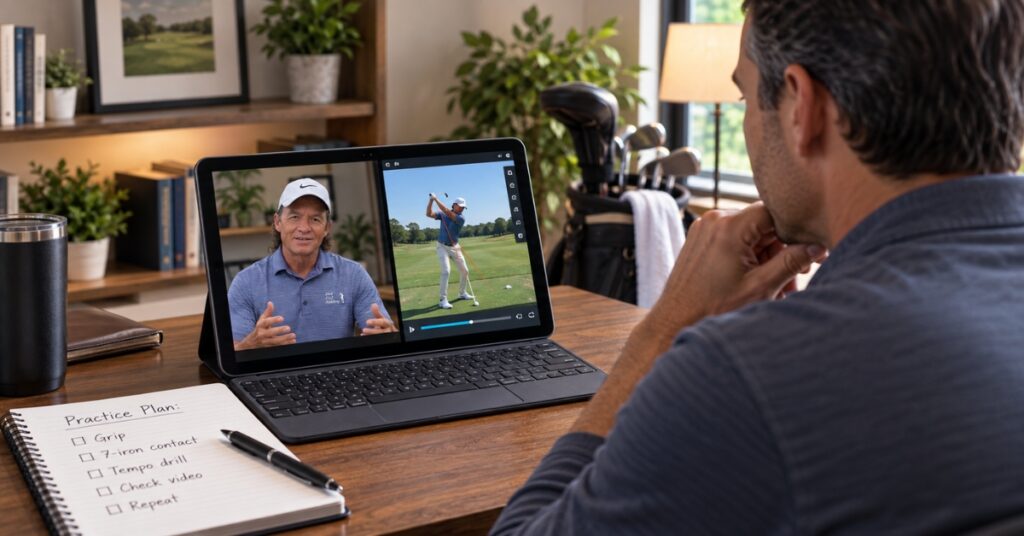
One of the biggest challenges golfers face between lessons is staying structured without constant feedback. You know what you’re supposed to be working on, but it’s hard to know if you’re doing it right. Doubt creeps in. Old habits sneak back. Progress stalls.
This is where Bird Golf Digital’s Pro Connect membership makes a real difference.
With Pro Connect, you’re not on your own between formal instruction. You get monthly live video coaching sessions with a Bird Golf Instructor, personalized swing analysis, and direct text communication through the Golf Live app. That means when you’re practicing and something doesn’t feel right, you’re not guessing. You can send a quick video, ask a question, and get expert feedback that keeps you on track.
The video lesson library also gives you a structured way to work on specific areas. If you’re trying to improve your wedge play, you can pull up the “Wedge Trajectory ToolKit” series and follow a clear progression. If your fundamentals need work, “Fundamentals: Cure the Cause” walks you through exactly what to focus on and how to practice it.
The difference between practicing alone and practicing with ongoing coaching support is massive. Alone, you’re hoping you’re doing it right. With Pro Connect, you know. And that confidence accelerates improvement in a way that solo practice never can.
Make Every Rep Count
Smarter practice doesn’t mean longer practice. It means more intentional practice.
When you show up with a focused plan, commit to quality over quantity, set small achievable goals, use slow-motion rehearsals, and avoid information overload, every minute you spend on the range moves you forward.
You’re not just hitting balls. You’re building a better swing, one purposeful rep at a time.
And when you pair that kind of practice with ongoing coaching support through something like Bird Golf Digital, the progress compounds. You maintain what you’ve learned. You stay connected to your instructor’s guidance. And you keep moving forward instead of spinning in place.
That’s how real improvement happens. Not from working harder. From working smarter.
